VFD SYSTEM DESIGN
Sine Wave Filters Work. Here's What They Can't Fix.
A technical look at what sine wave filters actually do — and the waveform problem they leave behind.
What a Sine Wave Filter Actually Does
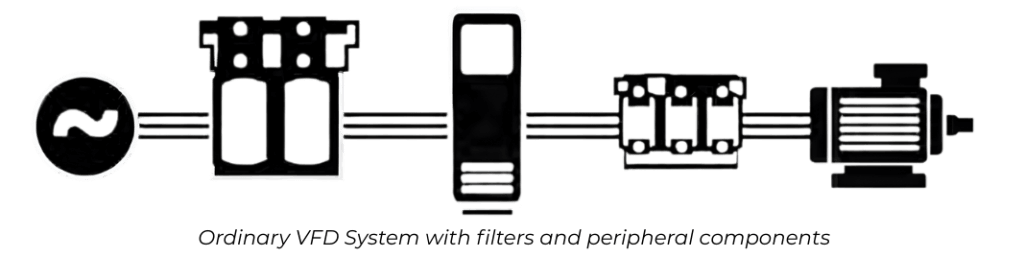
A sine wave filter is placed between a VFD and the motor. Using inductive and capacitive components, it reshapes the PWM output waveform before it reaches the motor terminals — reducing dV/dt, smoothing voltage rise time, and protecting motor insulation from the stress of fast-switching waveforms.
For engineers dealing with long cable runs, legacy motors, or repeated insulation failures, specifying a sine wave filter is sound, responsible practice. It works.
Why Engineers Specify Them
Sine wave filters show up in real projects for real reasons:
→ Cable runs over 100–150 feet where reflected wave overvoltage becomes a risk
→ Legacy or non-inverter-duty motors that weren’t designed for PWM stress
→ Recurring bearing or insulation failures with no other clear cause
→ Sensitive pump or HVAC applications where smooth torque matters
→ Environments where EMI from the drive disturbs nearby instrumentation
In each case, the filter addresses a specific symptom. That’s exactly what it’s designed to do.
What the Filter Leaves Behind
A sine wave filter reshapes the waveform after it leaves the drive. It does not change how the VFD generates power. That means several conditions remain unresolved, regardless of whether a filter is installed:
Viewed across a full installation, the pattern is consistent: non-ideal waveforms create stress, mitigations manage that stress, and each mitigation introduces new constraints. The system works — but it keeps getting more complex.
A Different Starting Point
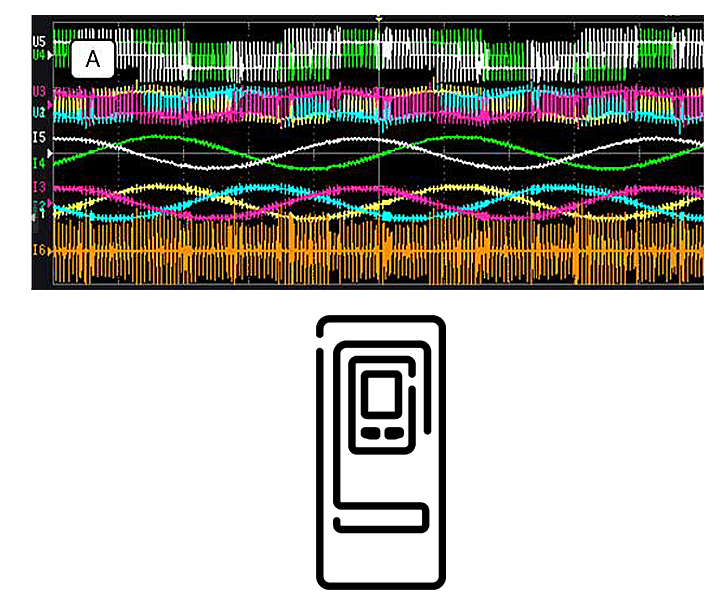
The reason conventional VFDs require downstream mitigation is architectural: IGBT�based inverters approximate a sine wave using high-frequency PWM switching. That approximation is what creates dV/dt, harmonics, and common-mode effects in the first place.
A fundamentally different approach addresses the waveform at the source — before it reaches the cable, the motor, or the supply.
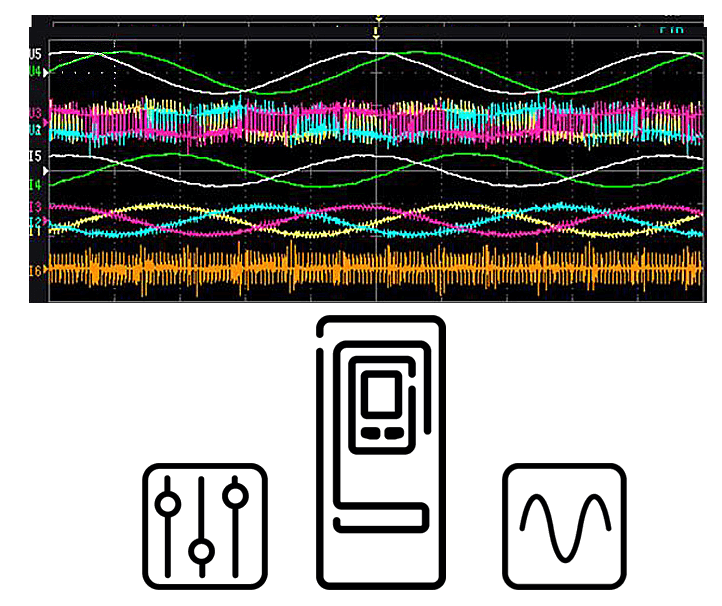
Silicon carbide (SiC) power devices switch faster and with lower losses than IGBTs — allowing the drive to produce a motor-safe sinusoidal waveform directly, rather than approximating one and correcting it externally.
The result: long cables stop being a special case. Legacy motors remain compatible. Panel complexity collapses. This is the foundation of the SmartD Clean Power VFD™.
Proven in the Field
Real installations. Real constraints. No filters.
MUNICIPAL WATER — UTILITIES
Énergir — Bearing Failures
Eliminated
Critical pump application with recurring bearing damage. Resolved without shaft grounding rings or output filters.
MUNICIPAL WATER — PUMP STATION
Saint-Sauveur — Simplified Retrofit
Pump station retrofit completed without output filters. Reduced panel size and commissioning time.
LONG CABLE RUN
1,400 ft Cable — No Output Filter
Extreme cable length that would typically mandate a sine wave filter. Ran without one.
INDUSTRIAL
ECCU — Motor Bearing Failures
Stopped
Eliminated recurring motor bearing failures across multiple units without additional mitigation hardware.
See if Your System Qualifies
Share a few basics about your application. We’ll tell you whether a reduced-mitigation architecture is a fit — and which components you may be able to eliminate. A SmartD engineer reviews every submission personally. No automated pitch, no sales sequence.
This post is also available in:
Français